


-
Products
- Local Securities
- China Connect
- Grade Based Margin
- Stock Borrowing & Lending
- IPO
- Stock Options
- Foreign Stocks
- Unit Trust
- Local Futures
- Foreign Futures
- Forex
- Bullion
- Insurance Services
- Bond
- Monthly Investment Plan
- Mortgage
- Other Services
- Surplus Cash Facility
- Phillip Premier
- Latest Insurance Promotion<
- Smart Minor (Joint) Account
- ETF
- Capital Management
- Research
- Market Info
- Education Center
- Phillip Apps
- Customer Service
- About Us
-
Surplus Cash Facility
Research Report
Author

章晶小姐 (Zhang Jing)
高級分析師
高級分析師
本科畢業於同濟大學工科,碩士畢業於華東師範大學金融貿系。現為輝立証券持牌高級分析師,主要負責汽車及航空板塊的研究,曾獲得《華爾街日報》亞洲區2012年度汽車及零部件最佳分析師第二名,擅長將行業前景與上市公司結合分析。
Bachelor Degree in Tongji University of Engineering; Master Degree in East China Normal University of finance. Currently cover automobile and air sectors. Having worked in research for years and is good at combining analysis for the companies with industry prospects.
| Phone: | 86 21 51699400-103 | Email: | zhangjing@phillip.com.cn | |
 For Research Report and Business enquiry For Research Report and Business enquiry | ||||
Spring Airlines (601021.CH) - International Route Rebound Continues
Tuesday, June 10, 2025  3603
3603
3603


Spring Airlines(601021)
| Recommendation | Accumulate |
| Price on Recommendation Date | $57.550 |
| Target Price | $65.500 |
Weekly Special - 2333 Great Wall Motor
Company Profile
Spring Airlines (hereinafter referred to as the "Company") is the leader of low-cost airlines in China, founded in 2004 and based in Shanghai. It adopts a single aircraft model (i.e., the Airbus A320 family) and only offers the economy class. The Company raises its passenger load factor (P L/F) mainly by attracting travellers through its parent company, Shanghai Spring International Travel Service Ltd. (Shanghai Spring Tour), offering charter flights through its subsidiaries, and providing special fares. Meanwhile, it enhances the aircraft utilisation rate to obtain a remarkable cost advantage by optimising the route structure, prolonging flight time, and accelerating turnover.
Investment Summary
Pre-tax Profit Remains Robust
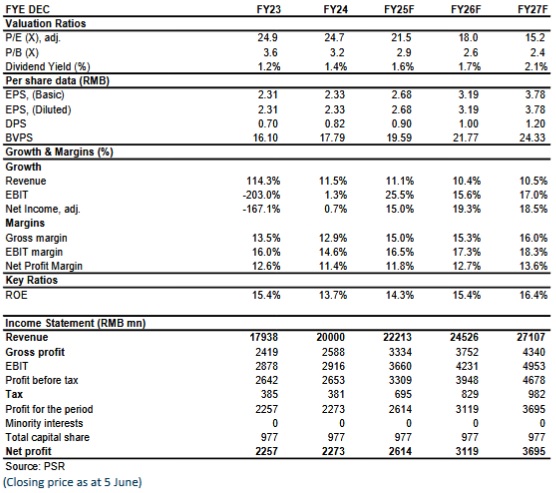
In 2024, Spring Airlines achieved operating revenue of RMB20 billion (RMB, the same below), up 11% yoy. Net profit attributable to the parent company reached RMB2.27 billion, up 0.7% yoy, while non-recurring net profit attributable to the parent company amounted to RMB2.25 billion, up 1.1% yoy. The Company distributed a cash dividend of RMB0.82 per share, with a payout ratio of approximately 35%.
In Q1 2025, the Company's operating revenue was RMB5.32 billion, up 2.9% yoy. Net profit attributable to the parent company was RMB680 million, down 16.4% yoy, while non-recurring net profit attributable to the parent company was RMB670 million, down 16.8% yoy. The decline in net profit was mainly due to the reduction of income tax expenses in the same period of previous years, as the tax shield was not utilised in 2024. However, the pre-tax profits for 2024 and Q1 2025 were RMB2.65 billion and RMB890 million, respectively, up 0.43% and 0.52% yoy, showing steady performance.
Solid Growth in Capacity and Strong International Route Performance
In 2024, the Company achieved a yoy growth of 18.8% in Revenue Passenger Kilometers (RPK), reaching 127% of 2019 levels. Domestic and international RPK grew by 9.8% and 95.4%, respectively, achieving 158% and 72.8% of 2019 levels. Available Seat Kilometers (ASK) grew by 16.1% yoy, reaching 126% of 2019 levels, with domestic and international ASK growing by 7.7% and 81.3%, respectively. The international route performance was particularly strong, with its share gradually recovering.
In Q1 2025, the Company's overall, domestic, and international RPK grew by 6.2%, -2.9%, and 61.6%, respectively. ASK grew by 6.9%, -3.3%, and 66.1%, respectively. The strong growth in international routes continued, while domestic routes were impacted by the repair of Leap-1A engines.
High Load Factor Maintained, but Yield Under Pressure
In 2024, the Company's average load factor was 91.5%, up 2.1 percentage points yoy. In Q1 2025, the load factor slightly declined by 0.6 percentage points to 90.6%, mainly due to the impact of a public opinion event in Thailand.
In 2024, the Company's revenue per available seat kilometer (RASK) decreased to RMB0.385, down 6.5% yoy, in line with the industry's downward trend. However, it remained above the industry average decline of 13%, and was up 6.4% compared to 2019. Domestic RASK was RMB0.373, down 6.35% yoy, while international RASK was RMB0.437, down 14.77% yoy, but grew by about 20% compared to 2019. In Q1 2025, the continued decline in industry ticket prices also led to a 3.14% yoy drop in Spring Airlines` RASK.
In 2024, the company's aircraft utilisation per day increased to 9.30 hours, up 9.41% yoy, partially offsetting the pressure from falling ticket prices. Additionally, the company's efforts in digital cost management began to show results, with unit ASK cost decreasing by 3.3% yoy, and unit ASK cost excluding fuel dropping by 1.7%. However, in Q1 2025, engine repairs limited aircraft utilisation, causing a 2.2% yoy increase in unit ASK cost excluding fuel. Despite this, the continued decline in oil prices benefited the company, reducing unit ASK cost by 2.3% yoy.
Fleet Expansion Continues
As of the end of 2024, the company's fleet consisted of 129 aircraft, with a net addition of 8 aircraft. It is expected that the fleet will reach 134, 146, and 160 aircraft in 2025, 2026, and 2027, respectively, with net additions of 5, 12, and 14 aircraft. In Q1 2025, the company's market share of capacity at Shanghai Pudong International Airport and Shanghai Hongqiao International Airport increased from 8.06% and 9.46% in the same period last year to 8.21% and 9.63%, respectively. We expect that the fleet expansion, continued recovery of international routes, higher aircraft utilisation, and cost improvements will contribute to sustained performance growth.In the long term, the low-cost airline business model is expected to continue penetrating the mass-market aviation travel sector. The company has a significant competitive advantage in both leisure and low-cost business travel segments. The company's growth momentum remains strong. However, due to factors such as ticket price declines and US-China tariffs, we are adjusting the company's EPS forecast.
Investment Thesis
Looking ahead, through the business model of low-cost aviation, the Company is expected to keep developing the mass aviation market and boasts its prominent competitiveness in sightseeing and low-cost business trips. There is still adequate momentum for future growth.
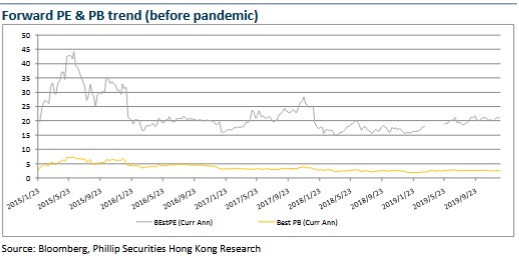
We revised the estimate for EPS for 2025/2026/2027 to be 2.68/3.19/3.78 yuan, respectively. We revised the Company's target price to RMB 65.5, respectively 24.5/20.5/17.3 x P/E, for 2025/2026/2027, a "Accumulate" rating. (Closing price as at 5 June)
Risk
Business cycle risk
Risk of jet fuel price fluctuation
Public health outbreak risk
Exchange rate fluctuation risk
Financials
This report is produced and is being distributed in Hong Kong by Phillip Securities Group with the Securities and Futures Commission (“SFC”) licence under Phillip Securities (HK) LTD and/ or Phillip Commodities (HK) LTD (“Phillip”). Information contained herein is based on sources that Phillip believed to be accurate. Phillip does not bear responsibility for any loss occasioned by reliance placed upon the contents hereof. The information is for informative purposes only and is not intended to or create/induce the creation of any binding legal relations. The information provided do not constitute investment advice, solicitation, purchase or sell any investment product(s). Investments are subject to investment risks including possible loss of the principal amount invested. You should refer to your Financial Advisor for investment advice based on your investment experience, financial situation, any of your particular needs and risk preference. For details of different product's risks, please visit the Risk Disclosures Statement on http://www.phillip.com.hk. Phillip (or employees) may have positions/ interests in relevant investment products. Phillip (or one of its affiliates) may from time to time provide services for, or solicit services or other business from, any company mentioned in this report. The above information is owned by Phillip and protected by copyright and intellectual property Laws. It may not be reproduced, distributed or published for any purpose without prior written consent from Phillip.
Top of Page
|
Please contact your account executive or call us now. Research Department Tel : (852) 2277 6846 Fax : (852) 2277 6565 Email : businessenquiry@phillip.com.hk Enquiry & Support Branches The Complaint Procedures |
About Us Phillip Securities Group Join Us Phillip Network Phillip Post Phillip Channel Latest Promotion 新闻稿 |
E-Check Login |
Investor Notes Free Subscribe |

|
Contact Us
About Us
Phillip Securities Group
Join Us
Phillip Network
Phillip Post
Phillip Channel
Latest Promotion
新闻稿
Phillip Securities Group
Join Us
Phillip Network
Phillip Post
Phillip Channel
Latest Promotion
新闻稿