


-
Products
- Local Securities
- China Connect
- Grade Based Margin
- Stock Borrowing & Lending
- IPO
- Stock Options
- Foreign Stocks
- Unit Trust
- Local Futures
- Foreign Futures
- Forex
- Bullion
- Insurance Services
- Bond
- Monthly Investment Plan
- Mortgage
- Other Services
- Surplus Cash Facility
- Phillip Premier
- Latest Insurance Promotion<
- Smart Minor (Joint) Account
- ETF
- Capital Management
- Research
- Market Info
- Education Center
- Phillip Apps
- Customer Service
- About Us
-
Surplus Cash Facility
Research Report
Author

研究部 (Research Team)
輝立証券
輝立証券
| Phone: | (852)22776555 | Email: | research@phillip.com.hk | |
 For Research Report and Business enquiry For Research Report and Business enquiry | ||||
Shenzhen-Hong Kong Stock Connect Series : Sector Overview - Healthcare
Thursday, November 3, 2016  13856
13856
13856


Shenzhen-Hong Kong Stock Connect Series
Weekly Special - 2333 Great Wall Motor
Overview
Healthcare industry can be broadly categorized into three main sectors, namely Medicine Production, Healthcare Services, and Equipment Production. The recent Chinese Government policy has been supportive to the healthcare industry as a whole, from healthcare service provider to medicine production and equipment production. Healthcare industry has been one of the hot sector in China and Chinese Government has started adopting long term supportive policies, such as `Healthy China 2030`, to improve not only the healthcare service industry and the medicine production industry, but also the overall health of the population.
Demographic Changes
China has an aging population, with 10.5% of the population, or 143.9 million people with age 65 years or above in 2015. This is a significant increase in comparison with the figure in 2011, which was stated that there were 9.1% of the population, or 122.9 million people, with age 65 years or above. According to Frost & Sullivan, the figure will further increase to 13.2%, i.e. 186.6 million people, by 2020.
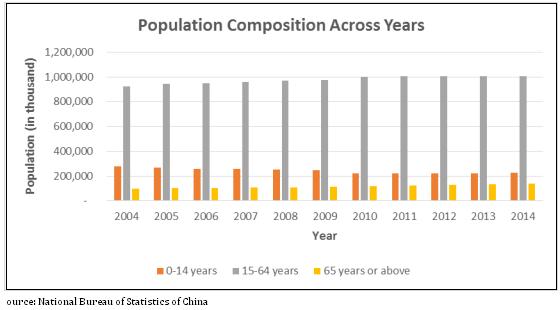
The chart above shows that the dominant part of Chinese population is the 15-64 years group while the 0-14 years group is slowly decreasing despite the increasing population. Therefore, as time progresses, 65 years or above group will slowly become a significant part of the population when 15-64 years group people ages.
Moreover, the life expectancy of the Chinese population is also increasing. Life expectancy rises from 68.6 years in 1990 to 76.3 years in 2015. With the rising life expectancy and the increasing elderly population, the demand for both healthcare products and services will increase. The increase in affordability to healthcare products and services, contributed by the rising disposable income, will also increase the demand, as evident by healthcare related expenditure increasing from CNY1,807 to RMB 2,856 per capita from 2011 to 2015.
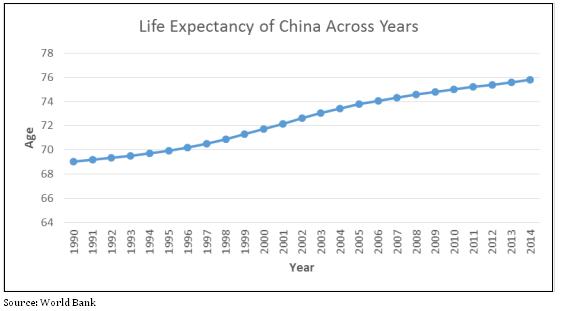
China successfully raised the average life expectancy by almost 8 years in 15 years. With the increase in coverage of social medical insurance across the population, the increase in expenditure to improve the medical system as a whole, and the continued growth of the Chinese economy and hence higher disposable income, we expect Chinese population to experience a further increase in life expectancy and hence the healthcare industry will continue to expand.
Government Support
The Chinese Government has adopted several measures that promote the development of the healthcare industry. In particular, the `Guiding Opinions on Promoting the Healthy Development of the Pharmaceutical Industry` was adopted in March 2016 and proposed measures such as providing financial support for innovation in drug industry as well as optimizing the approval process for innovative drug development. Apart from policy, the Chinese Government has a rising awareness to the health of the general public. In 2014, the social medical insurance covered 97.5% of the total population of China. The coverage of the social medical insurance will make healthcare service and products more affordable to the general public of China.
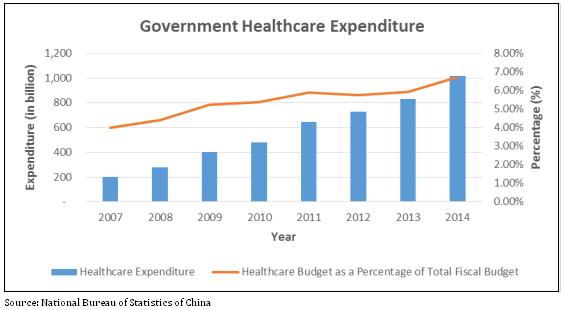
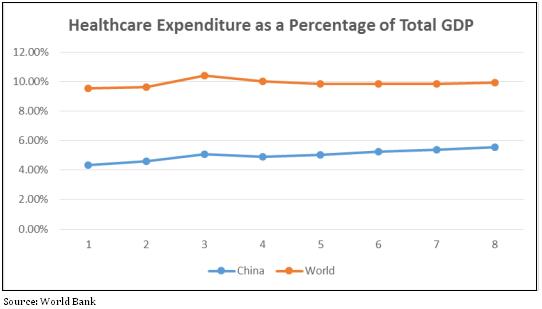
Healthcare expenditure is becoming increasingly significant in the fiscal budget and the total GDP of China. In particular, the healthcare expenditure as a percentage of the total GDP (5.55%) is still behind the average of the world (9.95%) and China still has a large gap before converging with the world standard of healthcare quality. On October 26, 2016, `Healthy China 2030` was approved and the bill seeks to improve the overall healthcare industry from the perspective of optimizing healthcare service system and protection, developing healthcare industry, and medical science development and innovation. `Healthy China 2030` is expected to benefit the entire healthcare industry
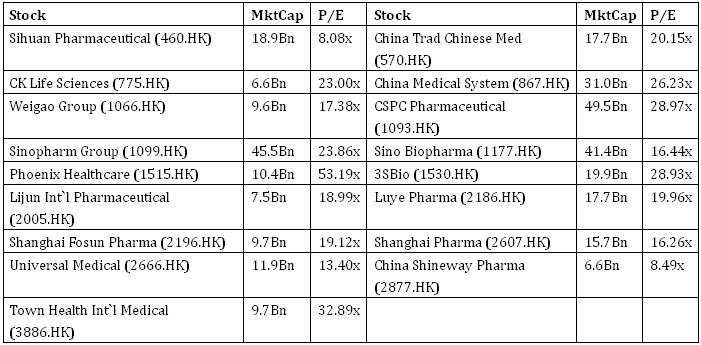
The following stocks are part of the healthcare sector stocks potentially eligible for Shenzhen-Hong Kong Stock Connect. The final eligible stocks for the Stock Connect will be announced by HKEX.
This report is produced and is being distributed in Hong Kong by Phillip Securities Group with the Securities and Futures Commission (“SFC”) licence under Phillip Securities (HK) LTD and/ or Phillip Commodities (HK) LTD (“Phillip”). Information contained herein is based on sources that Phillip believed to be accurate. Phillip does not bear responsibility for any loss occasioned by reliance placed upon the contents hereof. The information is for informative purposes only and is not intended to or create/induce the creation of any binding legal relations. The information provided do not constitute investment advice, solicitation, purchase or sell any investment product(s). Investments are subject to investment risks including possible loss of the principal amount invested. You should refer to your Financial Advisor for investment advice based on your investment experience, financial situation, any of your particular needs and risk preference. For details of different product's risks, please visit the Risk Disclosures Statement on http://www.phillip.com.hk. Phillip (or employees) may have positions/ interests in relevant investment products. Phillip (or one of its affiliates) may from time to time provide services for, or solicit services or other business from, any company mentioned in this report. The above information is owned by Phillip and protected by copyright and intellectual property Laws. It may not be reproduced, distributed or published for any purpose without prior written consent from Phillip.
Top of Page
|
Please contact your account executive or call us now. Research Department Tel : (852) 2277 6846 Fax : (852) 2277 6565 Email : businessenquiry@phillip.com.hk Enquiry & Support Branches The Complaint Procedures |
About Us Phillip Securities Group Join Us Phillip Network Phillip Post Phillip Channel Latest Promotion 新闻稿 |
E-Check Login |
Investor Notes Free Subscribe |

|
Contact Us
About Us
Phillip Securities Group
Join Us
Phillip Network
Phillip Post
Phillip Channel
Latest Promotion
新闻稿
Phillip Securities Group
Join Us
Phillip Network
Phillip Post
Phillip Channel
Latest Promotion
新闻稿