


-
Products
- Local Securities
- China Connect
- Grade Based Margin
- Stock Borrowing & Lending
- IPO
- Stock Options
- Foreign Stocks
- Unit Trust
- Local Futures
- Foreign Futures
- Forex
- Bullion
- Insurance Services
- Bond
- Monthly Investment Plan
- Mortgage
- Other Services
- Surplus Cash Facility
- Phillip Premier
- Latest Insurance Promotion<
- Smart Minor (Joint) Account
- ETF
- Capital Management
- Research
- Market Info
- Education Center
- Phillip Apps
- Customer Service
- About Us
-
Surplus Cash Facility
Research Report
Author

章晶小姐 (Zhang Jing)
高級分析師
高級分析師
本科畢業於同濟大學工科,碩士畢業於華東師範大學金融貿系。現為輝立証券持牌高級分析師,主要負責汽車及航空板塊的研究,曾獲得《華爾街日報》亞洲區2012年度汽車及零部件最佳分析師第二名,擅長將行業前景與上市公司結合分析。
Bachelor Degree in Tongji University of Engineering; Master Degree in East China Normal University of finance. Currently cover automobile and air sectors. Having worked in research for years and is good at combining analysis for the companies with industry prospects.
| Phone: | 86 21 51699400-103 | Email: | zhangjing@phillip.com.cn | |
 For Research Report and Business enquiry For Research Report and Business enquiry | ||||
Air China (753.HK) - Effects of Capacity-Control and Price-First Strategies continued
Friday, December 15, 2017  19044
19044
19044


Air China(753)
| Recommendation | Accumulate |
| Price on Recommendation Date | $8.060 |
| Target Price | $8.670 |
Weekly Special - 002050 Sanhua
Investment Summary
- 15% Increase in Profit of 2017Q3
- Remarkable Effects of Capacity-Control and Price-First Strategies
- It will be helpful to benefit from the economic recovery in Europe to operate jointly with Lufthansa
Valuation & Investment thesis
According to the latest result, we revised our estimate 2017/2018 net profit of AC to be 9.68/9.55 billion RMB; EPS to be 0.67/0.66-yuan RMB. The target price is adjusted to HKD8.67, estimates 11x/11x P/E and 1.45/1.31x P/B in 2017/2018. “Accumulate” rating is given.
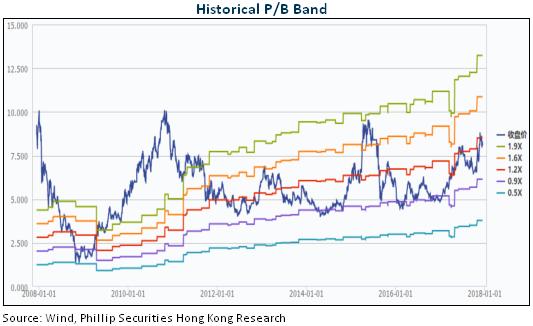
15% Increase in Profit of First Three Quarters of 2017
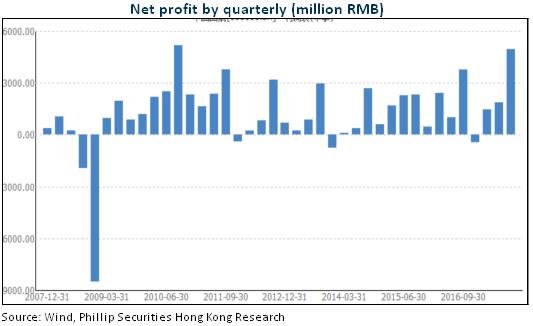
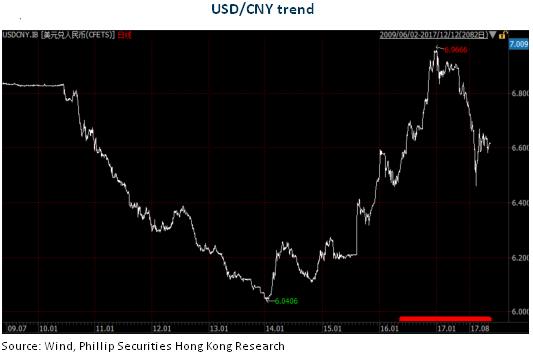
According to AC's report of the first three quarters (Chinese Accounting Standards), it recorded a revenue of RMB92,996 million for the first nine months of 2017, with yoy growth of more than 8.8%. The net profit attributable to the parent company was increased by 14.6% to RMB8.28 billion, with a basic EPS at RMB0.62. AC's EPS in Q1, Q2 and Q3 was RMB0.10, RMB0.13, RMB0.34, respectively, reduced by 47%, rocketed by 63% and increased by 17% yoy, respectively, from last year's RMB0.19, RMB0.08, RMB0.29, respectively. The faster growth of revenue in comparison with operating cost and the substantial savings in financial costs for the appreciation of RMB were the main causes for result growth.
AC's financial cost of the first three quarters was only RMB66.34 million due to exchange gains, down by 99.6% Y-o-Y, which was the largest drop in the three major airlines. AC's net profit slightly slipped by 3.6% to RMB6.81 billion in 2016, which were lower than our estimate of 23%. Limited by the bottleneck of Capital International Airport, this was mainly due to lower-than-expected revenue growth and higher-than-expected financial expense as well as income tax rates.
Remarkable Effects of Capacity-Control and Price-First Strategies
AC implemented cautious capacity-control and price-first strategies, with both its P L /F and profitability increased, and maintained its leading position in the three major airlines.
In the H1 of the year, AC had a net increase of five aircraft. Accelerating the introduction of capacity in the H2 of the year, there was a net increase of 15 aircraft in Q3. The fleet currently has 643 aircraft, including 253 aircraft owned by itself, 185 aircraft in the form of finance leases and 205 aircraft in the form of operating leases. According to the plan, there will be a net increase of 18 aircraft in Q4. From 2018 to 2019, the company has a plan of a net increase of 33 and 41 aircraft, with Boeing 737 and Airbus A320/321 as main models.
In the first three quarters, the company's capacity and volume increased by 5.5% and 5.1%, respectively. The growth rate was slower than that of CEA and CSA. Its P L /F increased to by 0.3 ppts to 81.2%, wherein the international routes maintained stable, and domestic and regional routes were improved. RPK rose by 1.43% in the H1 of year and rose by 5.2% in Q3. The company continued to promote the construction of hubs around Beijing, Shanghai, Chengdu and Shenzhen, optimized the price gradient of two domestic cabins (first-class cabin and business class cabin) and expanded customers` breadth of two international cabins. As a result, this gave rise to significant increase in the overall revenue level of two cabins and revenue proportion.
It will be helpful to benefit from the economic recovery in Europe to operate jointly with Lufthansa
In the H1 of 2017, AC announced the official joint operation with Lufthansa AG. Both parties will enhance the service level in China-Europe routes and overall competitiveness in the European market by coordinating flight schedules, implementing plans of joint major clients and further optimizing flight plans of frequent passengers. Both parties will adopt unified pricing on the joint venture routes, and then determine the income ratio according to the number of seats and models that they have invested in. This is a more in-depth cooperation mode in comparison with code sharing. After the affiliation, it will be convenient for AC's passengers to make use of aviation hubs in Frankfurt, Munich, Zurich and Vienna for a round-trip ride.
For AC, this will directly complement the airline network between European hub market and domestic second-tier cities, strengthen flight densities between European airline hub and domestic first-tier cities, enhance International airline passengers` experience and stickiness, as well as enabling AC to have a higher fare-increase flexibility in peak seasons. We hold the view that the European aeronautical market is moving away from the terrorist attacks and will benefit from the demand-improving effects brought by European economic recovery.
Risk
Traffic demand languished for the deterioration of macro-economy;
The depreciation of the RMB against USD would bring exchange loss;
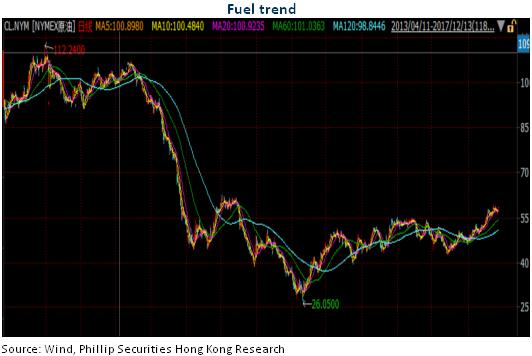
Oil prices rose exceeded forecast.
War, terrorist attacks, SARS and other emergencies;
Highspeed railway diversion
Financials

This report is produced and is being distributed in Hong Kong by Phillip Securities Group with the Securities and Futures Commission (“SFC”) licence under Phillip Securities (HK) LTD and/ or Phillip Commodities (HK) LTD (“Phillip”). Information contained herein is based on sources that Phillip believed to be accurate. Phillip does not bear responsibility for any loss occasioned by reliance placed upon the contents hereof. The information is for informative purposes only and is not intended to or create/induce the creation of any binding legal relations. The information provided do not constitute investment advice, solicitation, purchase or sell any investment product(s). Investments are subject to investment risks including possible loss of the principal amount invested. You should refer to your Financial Advisor for investment advice based on your investment experience, financial situation, any of your particular needs and risk preference. For details of different product's risks, please visit the Risk Disclosures Statement on http://www.phillip.com.hk. Phillip (or employees) may have positions/ interests in relevant investment products. Phillip (or one of its affiliates) may from time to time provide services for, or solicit services or other business from, any company mentioned in this report. The above information is owned by Phillip and protected by copyright and intellectual property Laws. It may not be reproduced, distributed or published for any purpose without prior written consent from Phillip.
Top of Page
|
Please contact your account executive or call us now. Research Department Tel : (852) 2277 6846 Fax : (852) 2277 6565 Email : businessenquiry@phillip.com.hk Enquiry & Support Branches The Complaint Procedures |
About Us Phillip Securities Group Join Us Phillip Network Phillip Post Phillip Channel Latest Promotion 新闻稿 |
E-Check Login |
Investor Notes Free Subscribe |

|
Contact Us
About Us
Phillip Securities Group
Join Us
Phillip Network
Phillip Post
Phillip Channel
Latest Promotion
新闻稿
Phillip Securities Group
Join Us
Phillip Network
Phillip Post
Phillip Channel
Latest Promotion
新闻稿